
TAB · Data science project
Credit Card Fraud Detection
Catching card fraud while cutting the cost of false alarms
- Lower cost than baseline
- 93%
- Fraud caught (recall)
- 82.4%
- Alerts that are fraud (precision)
- 75.0%
The problem
Only 0.172% of transactions are fraud: 492 out of 284,807. Flag too much and analysts drown in false alarms; flag too little and fraud gets through. So instead of chasing accuracy, this project scores every model on what it costs the bank: $124 for each missed fraud and $25 for each false alarm.
The data
Credit Card Fraud Detection dataset, ULB Machine Learning Group (Kaggle) ↗
284,807 transactions by European cardholders (September 2013), with 28 anonymized features plus time and amount
Approach
- Removed 1,081 duplicate transactions and added time-of-day and log-amount features.
- Compared five models: logistic regression with class weights, logistic regression with SMOTE oversampling, random forest, tuned XGBoost and a neural network.
- Judged each model by its total business cost, along with ROC-AUC, PR-AUC, precision and recall.
- Tested 99 decision thresholds for the random forest to find the cheapest one, and explained its predictions with SHAP.
Results
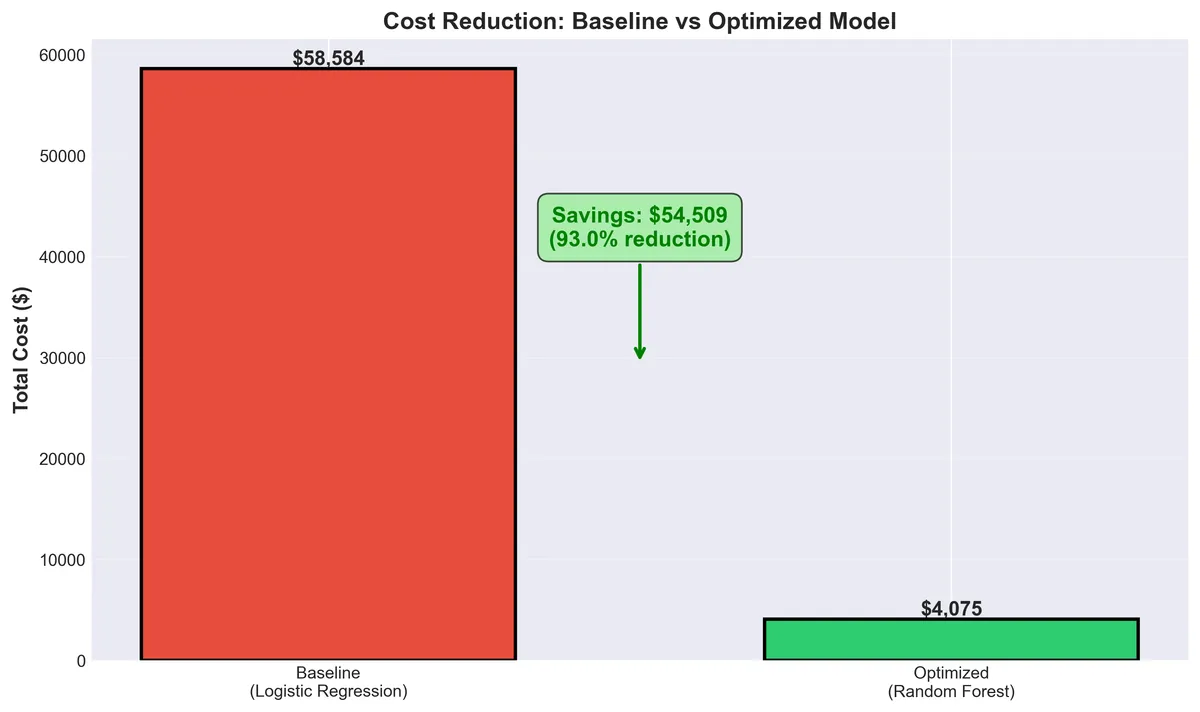
At a threshold of 0.13, the random forest cut total cost from $58,584 (the baseline logistic regression) to $4,075, a 93% reduction. It catches 82.4% of fraud, and 75.0% of its alerts are real fraud (ROC-AUC 0.954). The baseline caught slightly more fraud but raised 2,264 false alarms; the final model raises 39.
What I'd do next
- Try autoencoders, which learn what normal transactions look like and flag the ones that don't fit.
- Serve the model through a REST API for real-time scoring.
Tools
- Python
- scikit-learn
- XGBoost
- TensorFlow
- imbalanced-learn
- SHAP
- pandas